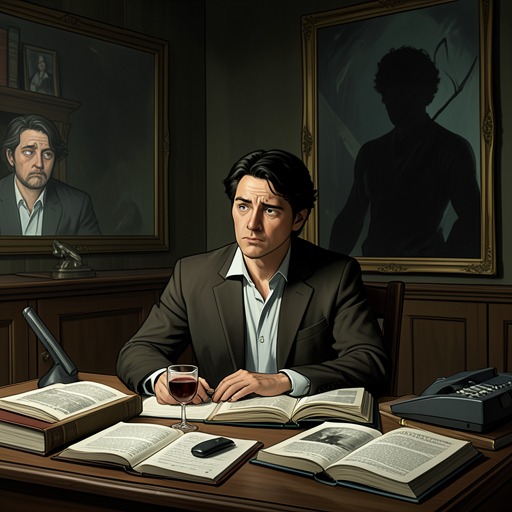
Walt Whitman
A History of the Vampire in Popular CultureWalt Whitman occupies a brief but revealing place in the account of Bram Stoker’s life and the possible emotional sources of Dracula. He is identified as the renowned American poet who became the most notable focus of Stoker’s affections, making Whitman important not because he participates in the novel’s plot, but because his public literary presence helps illuminate the desires and contradictions surrounding its author.
Public Image and Literary Reputation
Whitman was widely assumed to be homosexual, and that assumption was reinforced by the character of his poetry. His work was noted for its openness about sensual pleasure and the beauty of the human form, qualities that made the body a conspicuous source of poetic value rather than something to be concealed beneath moral abstraction. In the context of Stoker’s life, Whitman therefore represented a highly visible literary figure through whom questions of desire, bodily experience, and social prohibition could be approached indirectly.
The Body in Whitman’s Poetry
The poem “I Sing the Body Electric,” written by Whitman in 1855, gives concentrated expression to this emphasis on physical and emotional connection. Its imagery joins bodies together through love, describing the speaker as surrounded by those he loves and bound to them in return. The poem asks whether the body does as much as the soul and whether the body might itself be the soul. Those questions challenge a simple division between physical desire and spiritual worth, treating bodily experience as a form of knowledge and identity rather than as a merely corrupting force.
The poem was originally untitled and was included in Leaves of Grass. Its placement within that collection matters because Leaves of Grass is presented as a work whose sensual frankness contributed to the assumptions about Whitman’s sexuality. Whitman’s poetry thus functioned simultaneously as literary expression and as a public surface onto which readers projected ideas about the poet’s intimate life.
Connection to Bram Stoker
Stoker’s attachment to Whitman is situated within a broader account of desires that, in his period, could not have been expressed publicly without disgrace. The evidence does not establish a simple causal claim that Whitman directly supplied the subject matter or symbolism of Dracula. It does, however, identify Whitman as the strongest documented focus among Stoker’s affections for men and places that attachment beside Stoker’s marriage, his lifelong friendship with Oscar Wilde, and his intense working relationship with Henry Irving.
This context makes Whitman more than a biographical footnote. His poetry offered a language in which the body could be celebrated, joined to love, and placed in uncertain relation to the soul, while Stoker lived within a culture that condemned such desires when made explicit. The contrast helps explain why the discussion of Dracula turns toward the possibility that Stoker was using fiction to make sense of personal desires that could not safely be named in ordinary public life.
Contradiction and Historical Significance
Whitman’s presence also sharpens the contradiction in Stoker’s later public position. In 1912, Stoker declared that homosexual authors ought to be imprisoned, a statement that some historians interpret as a smokescreen intended to conceal his own illicit desires. The evidence presents this not as a settled verdict on Stoker, but as an unresolved tension between the poet who most strongly attracted his affections and the moral condemnation he publicly articulated.
Whitman consequently stands at the intersection of literary influence, concealed feeling, and social repression. His poetry gives the body a dignity that cannot easily be separated from the soul, while Stoker’s biography shows the risks of acknowledging desire in the period in which Dracula was written. The connection remains suggestive rather than definitive, but it reveals how the cultural meaning of Whitman’s work could extend beyond its poems into the private emotional history of one of the era’s most influential writers of Gothic fiction.